Showing posts with label Lewis. Show all posts

Saturday, February 11, 2017

Weekly Links!


~ LINKS TO SOME INTERESTING READING & Watching, FOR WHAT'S LEFT OF YOUR WEEKEND ~

-"Not Writing for Writers": I enjoyed this post about how pursuing non-literary art forms help writers write better. Here's a snippet:
What amazes me the most is that I haven’t lost anything. I don’t have less time to enjoy the audiobooks and films and tv shows and social media I love. But I have incentive to be more purposeful about what I consume, because it has to be better than spending time with my thoughts. I’ve lost patience for the empty noise, I only want the good stuff.

-"On Signaling Versus Displaying Virtue in a Trumpian Age"


-"How the Order of the Beatitudes Could Change Your Life": I can't remember ever seeing this point made elsewhere, and it's a really helpful insight.


-"I Work from Home":  I'm enough of an introvert that I can't identify with much of this, but as someone who does work from home, I still find it hilarious.


-"Dear Supporter, There's So Much More I Wish I Could Tell You": a missionary friend of mine linked to this post, and (for what it's worth) as a missionary kid, I commend it to you.

Pray for the missionaries you know, folks. And then pray for them some more.


-"Ten Meter Tower": I could not look away from this. Weirdly fascinating.


-"C.S. Lewis Talks to a Dog About Lust": So helpful.


-"Why Our Son Doesn't Have a Smartphone"


-"I Was a Black, Female Thru-Hiker on the Appalachian Trail"


-"An Iceberg Flipped Over, and Its Underside is Breathtaking": really gorgeous pictures.


-"Which Paid Marketing Works (and Doesn't Work) for Books": I know this is totally inside baseball, but I like Rachel Aaron's blog (and recommend her book), and found this long meaty post really interesting.


---Finally, on a note of shameless self-promotion, it's almost Lent, and if you don't already have a copy of "Let Us Keep the Feast: Living the Church Year at Home," now is a great time to buy one! Cate MacDonald and Lindsay Marshall do a great job of showing you simple, meaningful ways to bring the church's celebration of Lent and Easter into your own home.

You won't regret getting yourself a copy before Ash Wednesday rolls around (March 1, this year.)---


I hope you have a lovely Sunday, full of worship and rest!

Peace of Christ to you,
Jessica Snell


This post contains Amazon affiliate links; if you purchase a book from this link, I receive a small percentage of the purchase price.  (See full disclosure on sidebar of my blog.)

Wednesday, June 1, 2016

C. S. Lewis, the Thief

This book brought to you by Paradise Lost (among others).


If you want a really boring drinking game, read modern Christian non-fiction and take a drink every time one of the authors quotes C. S. Lewis.

It’s boring for two reasons: first, because they all do it. So there’s really no suspense. But it’s also boring because they’re only going to do it every few chapters, and so you’re going to stay stone-cold sober.

Now, if you want an interesting drinking game, read the old Western canon of classics and take a drink every time you find something that was stolen by C. S. Lewis.

You’ll still be sober (‘cause the classics take a good long while to read) but you’ll come away astonished by what a thief Lewis was.

Make that: what a skilled thief.

My favorite is probably his theft from Milton. You know that memorable passage in The Magician’s Nephew where the lion, Aslan, sings Narnia into creation? The dirt around him starts bubbling like an unwatched pot and out of each bubble springs a new animal: an elephant, a dog, a jackdaw.
It’s such a beautiful passage, and such a beautifully odd passage. Very Lewisian.

And he completely lifted it from Milton’s Paradise Lost.  My jaw dropped when I stumbled across that one.

It’s like that for a lot of Lewis’ brilliant passages.

I remember reading through Aristotle for the first time, and thinking, Oh, this is where Lewis got his stuff about habits, and about what a thing is vs. what it’s made of. When I got to Boethius, I realized, Oh, this is where Lewis learned that it is the person we become that is more permanent and important than the hardships we suffer. When I read Plato…

Well, it’s all in Plato, isn’t it? (Bless me, what do they teach them in these schools? DRINK.)

Once I saw it in Lewis, I started seeing it other places, of course. Authors have been stealing from each other forever and—even better—riffing off each other. (“Oh, you liked Marlowe’s The Passionate Shepherd to His Love, did you?” asks Sir Walter Raleigh. “Wait till you read my The Nymph’s Reply!”) Once you twig on to it—and I imagine most readers do somewhere around high school or college—playing “find the stolen source” can liven up just about any reading experience.

But Lewis thefts are still my favorite. Maybe it’s because he’s the best at integrating everything he takes into one, coherent worldview. (And aren’t we all going for that? Hoping to make sense of the world on that level?) Maybe it’s because being already familiar with his work when I approached those daunting, dusty Greek and Roman texts made them feel almost homey, and I’ll never cease to be grateful for the help.

Or maybe it’s just because he’s the author who seems to be having the most fun doing it. I mean, lifting the phrase “for tool, not toy meant” out of a serious, devout poem by a Roman Catholic priest and then placing those same words (slightly twisted!) into the mouth of Father Christmas in a fairy tale for children?

That’s skill. That’s delight.

So, try the Lewis game! But remember, to really play it right, you have to read lots of books. And lots of your lots of books should be old books. Always remember, as the great writer C. S. Lewis said:  “to keep the clean sea breeze of the centuries blowing through our minds…can only be done by reading old books.”


(And that was a freebie for you: me quoting Lewis to give you more points. DRINK!)


Peace of Christ to you,
Jessica Snell


p.s. The drinking game suggestion is a joke, folks, don't yell at me...

This post contains Amazon affiliate links; if you purchase a book from this link, I receive a small percentage of the purchase price.  (See full disclosure on sidebar of my blog.)

Sunday, March 13, 2016

Weekly Links: on clean houses, that one TV hairstyle, and more!

Jack is judging you.

SOME GOOD READING FOR YOUR SUNDAY AFTERNOON...


Faith

-"Reading the Danvers Statement II" - about men and women and the Bible. Here's a snippet:
Sure, these scriptures are for every culture. Nobody reading the bible should think that it is ever just for them. It is for the whole world. And so every single culture should read the bible. But that’s the point. I think every person should read the bible–the whole bible. And when that happens, some interesting things might happen.
-"Why I Quit Watching Downton Abbey" - on suffering and stories (maybe I put this link in the wrong section); here's a snippet:
The best way to honor sad stories is to simply present them as such. To not rush to a tidy conclusion, to not veer quickly off into either redemption or revenge. To honor the victim, to look unblinkingly at the trauma, to hold the story in your heart and then to tell others—this is what we are supposed to do.


Family


-"9 Habits of One Mother Trying to Keep a Clean Home" - I admit to reading this more than once. Bethany is pretty inspiring.


Fiction


-"Welcome to the Medical Clinic at the Interplanetary Relay Station" - another good one from Lightspeed. Remember those choose-your-own-adventure paperbacks back from when we were kids? This short story is that style, but hilariously pessimistic.

-"The Overlooked Hope for Narnia's Susan Pevensie" - I admit to thinking something similar before. Such a good rebuttal to the popular view that Lewis was just being a sexist pig when it came to Susan! (Not that maybe he couldn't have been sometimes - and he'd be the first one to admit he was a sinner with blindspots - but I've always thought the popular criticism of Susan's fate was unfair, and this article's a good take on that.)

-"Why Everyone on TV Has the Same Hair" - I found this fascinating, because I'd noticed this (extremely boring visually) trend. The explanation makes sense! (But still folks: change it up!)


Hope the rest of your weekend is restful and good!
-Jessica Snell


Monday, November 23, 2015

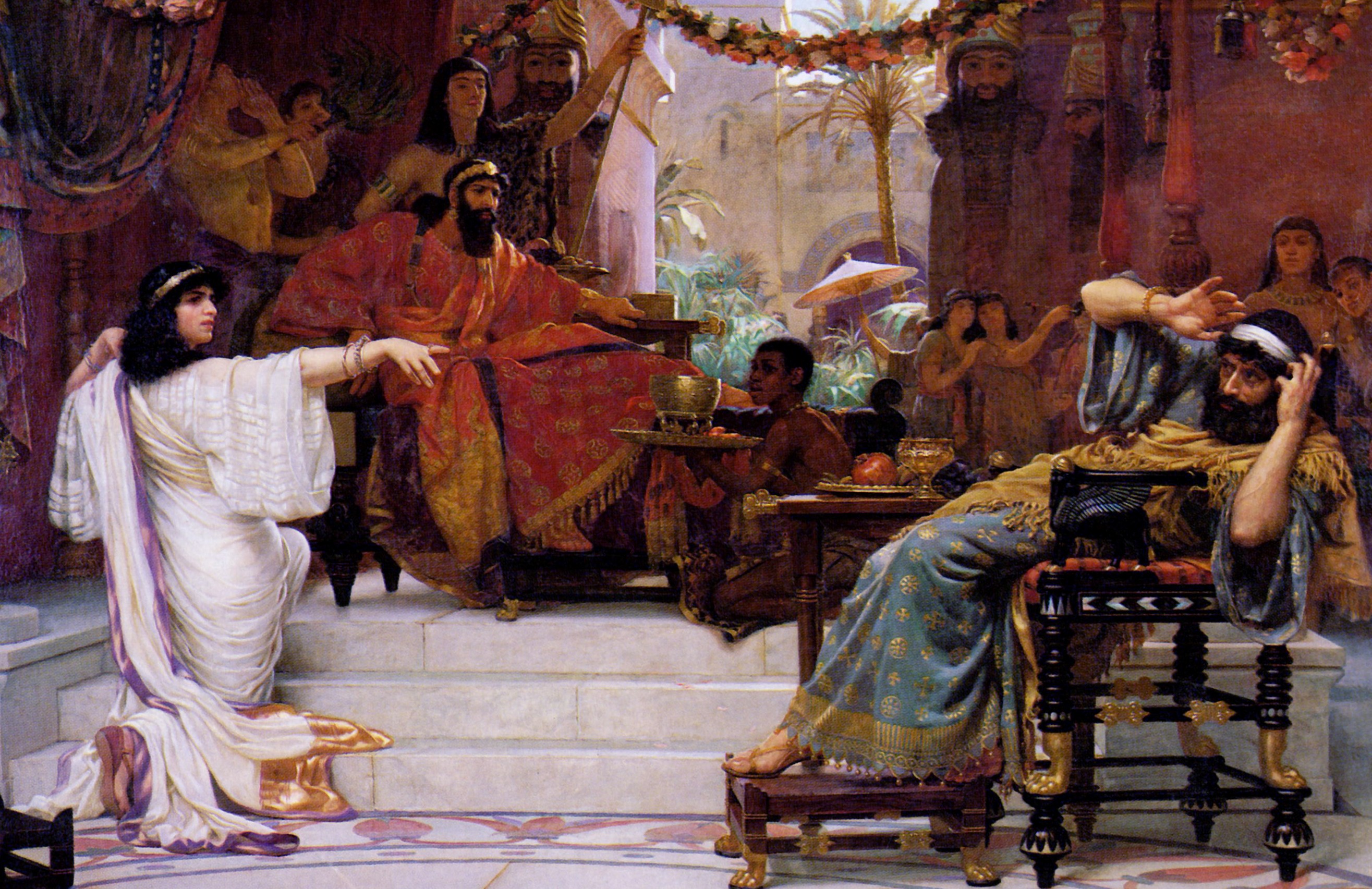
Haman & Esther, Judas & John

"Esther Denouncing Haman", by Ernest Normand, via Wikimedia Commons, public domain.

My Bible reading this past week had me in the Old Testament book of Esther and this time through it, a new part of the story caught my attention. In Esther 4, Mordecai tells Esther that if she doesn't act bravely, help will surely arise for the Israelites from another place.

There is faith, if you want it. Mordecai allows that Esther might fail to do her part . . . but God won't.

Mordecai trusts in God, but he declares to Esther that it makes a difference to HER whether or not she is willing to serve, whether or not she is willing to adventure her life on behalf of God's people.

Here is the verse in question:
For if you keep silent at this time, relief and deliverance will rise for the Jews from another place, but you and your father's house will perish. And who knows whether you have not come to the kingdom for such a time as this?
It's the second half of that verse that's more famous - the "for such a time as this" bit.

But it's the first that struck me this time through: "if you keep silent . . ." deliverance will still arise.


It reminds me very strongly of C. C. Lewis' observation in The Problem of Pain:

For you will certainly carry out God's purpose, however you act, but it makes a difference to you whether you serve like Judas or like John.

Or, we might say, after reading this story, whether you serve like Esther or like Haman.

Peace of Christ to you,
Jessica Snell


This post contains an Amazon affiliate link; if you purchase something from this link, I will (gratefully!) receive a small percentage of the purchase price.  (See full disclosure on sidebar of my blog.)

Monday, September 1, 2014

Anxiety, "The Problem of Pain", and work


So, I had a day last week that was really hard. It was hard in a parenting sense. It was hard in an anxiety sense. It was just hard.

And I decided (God's grace!) to meet the anxiety with faith and with - here's the surprise - with work.

I'm learning, more and more, that the thing to do with anxiety is to meet it square. Not deny it, not run from it, not pretend it's not there. But just to say, "Oh, there you are. I see you. I accept you're there. And now I get to choose what to do."

And so often, the right thing to do in answer to anxiety is to go to work.*

Activity, even if it has nothing to do with the worry at hand, is amazing for dismissing anxiety.**

The value of work 
Stopping, praying, journaling, and then getting actively to work . . . it’s everything. It’s the difference between despair and joy.

And that’s not running away from the fear. It’s not hiding it or denying it. It’s saying, “Here it is. I see it. And” – not but. And – “I am going to do this.”

On that hard day though, all the same, I was so glad when my husband came home.  He sanes me. And if "sanes" is not a verb, it should be.  

Also, another thing that really helped me was some quotations I'd copied down from my reading. Rereading the words of wiser Christians is terribly grounding.

Lewis on pain
Speaking of quotations from wiser Christians, I also want to copy down, oh, all of the chapter entitled “Heaven” from Lewis’ “The Problem of Pain”. But I’m not sure that’s very practical.

First Lewis talks about the jeer “pie in the sky” and observes either there is pie in the sky or there isn’t . . . and that it’s safe to talk about heaven to the pure in heart, because there’s nothing in heaven any mercenary soul would want. Those who love God are the ones who want to see Him.

And then he talks about his idea of “joy”, and oh, it’s glorious. The thing I’ve been looking for all my life . . . and I realized that that, really just that, is the reason why, in the end, I write fiction. Because it is the time I come the closest to grasping – and to expressing – that thing it is that I see
always on the edge of breaking through” – that thing that “beneath the flux of other desires and in all the momentary silences between the louder passions, night and day, year by year, from childhood to old age, you are looking for, watching for, listening for . . . you have never had it. All the things that have ever deeply possessed your soul have been but hints of it – tantalizing glimpses, promises never quite fulfilled, echoes that died away just as they caught your ear. But if it should really become manifest – if there ever came an echo that did not die away but swelled into the sound itself – you would know it. Beyond all possibility of doubt you would say ‘Here at last is the thing I was made for.’
Yes. That. It's what I mean when I talk about "domestic glory". It is the “home” theme that shows up in all my stories. It’s what I mean when I talk about the scent of the sea and roses against the white-and-blue sky. But . . . but it’s not quite any of them. It’s what draws me to romance, and yet also to science fiction and fantasy. It’s that boundless horizon married to the sweet comfort of a snug house. It’s . . . yes. It’s that thing.

And then Lewis points out that God put this difference in all of us – that He made us individuals on purpose, and that this secret, unique hunger in each of us is no mistake:
Be sure that the ins and outs of your individuality are no mystery to Him; and one day they will no longer be a mystery to you.
And then he points out:
For it is not humanity in the abstract that is to be saved, but you – you, the individual reader, John Stubbs or Janet Smith. Blessed and fortunate creature, your eyes shall behold Him and not another’s. All that you are, sins apart, is destined, if you will let God have His good way, to utter satisfaction.
And oh, that makes me want to let God have His good way with me! Be gone, oh sins.

And then Lewis goes on to his next point, and it really, really resonated with me after the way work seemed to be what saved me from despair, just a few days ago:
And if you will not go out of yourself to follow it, if you sit down to brood on the desire and attempt to cherish it, the desire itself will evade you. ‘The door into life generally opens behind us’ and ‘the only wisdom’ for one ‘haunted with the scent of unseen roses, is work.’ This secret fire goes out when you use the bellows: bank it down with what seems unlikely fuel of dogma and ethics, and then it will blaze.
I am reinspired by the idea to “do my work with gladness while it is day, that when night cometh, I may rejoice to give thee thanks”.

And it gives me an entirely different way to look at that hard day's difficulties. When my child's  meltdown, and the scary money costs of dental work tempt me to despair – and even less (or more) than that, to whine and pout and complain – instead, these words of Lewis show me that my troubles are actually not just difficulties or attacks.

They are part of the work God has given me to do.

How do I say this properly? Because I see it really clearly, and I want to get it down in words so that I don’t forget it in other times.

These trials, these worries, these events, these hardships . . . they’re just part of the work. They’re not threats. Because they are allowed by God, and he has allowed them to come in my way, which means that He means to help me deal with them. It’s not me cowering in a corner being hit. It’s me walking in the way my Lord has directed me to walk, ready to take care of what’s in front of me because those are the tasks he’s asked me to take care of.

Do you see? There’s such a difference there.


And, with that, I go to work.


Peace of Christ to you,
Jessica Snell


*Other times the right thing to do is to build a blanket fort and borrow in for the day. Just saying.
**Clinically significant anxiety is not necessarily why I'm talking about. For that, psychotherapy and medication may also be necessary and commendable and even life-giving. Really, truly.


This post contains Amazon affiliate links. (See full disclosure on sidebar of my blog.)

Sunday, January 12, 2014

Weekend Links - wine, vaccines, and more!

Interesting reading from around the Web:

"We made a sommelier taste all the Trader Joe's Two-Buck Chuck":
Here's the thing, though: some of it's actually pretty damn good, and could easily be sold as Nine-to-Eleven-Buck Chuck without anyone being the wiser.
So we brought in two devoted tasters to blindly drink eight different types of Charles Shaw Blend, hit us with detailed notes, and determine 1) which bottles are totally palatable and even enjoyable, and 2) which should be avoided as if they were made by Chuck Woolery, who, it turns out, makes terrible wine.
"Growing Up Unvaccinated":
Pain, discomfort, the inability to breathe or to eat or to swallow, fever and nightmares, itching all over your body so much that you can’t stand lying on bed sheets, losing so much weight you can’t walk properly, diarrhea that leaves you lying prostrate on the bathroom floor, the unpaid time off work for parents (and if you’re self employed that means NO INCOME), the quarantine, missing school, missing parties, the worry, the sleepless nights, the sweat, the tears and the blood, the midnight visits to A and E, sitting in a doctor’s waiting room on your own because no one will sit near you because they’re rightfully scared of those spots all over your kid’s face.
Those of you who have avoided childhood illnesses without vaccines are lucky. You couldn’t do it without us pro-vaxxers. Once the vaccination rates begin dropping, the less herd immunity will be able to protect your children. The more people you convert to your anti-vax stance, the quicker that luck will run out.

"Celebrating Epiphany": I love Ann's ideas for month-long celebration! Very creative and family-friendly.

"The God of the Coming Year":
And Osteen’s books be damned, you may have the worst year of days you have ever seen.
"Resolve to Resolve":
In the place where hope meets grace, there is God. God is where resolutions become effective. God is where change happens. Grace is the answer to the naysayers, those voices both within and without who say that you cannot start afresh. Grace is the breath of fresh air in April when the resolutions of the new year and even the Lenten promises look like one big heap of failed attempts at perfection. Grace reminds us that His power is made perfect in our weakness and the true growth in holiness is in the soul’s earnest effort. Grace is sufficient. Sufficient? It’s abundant.
"Rainbow Rowell and the World with No Rules":
. . . YA novels should be written for teen readers, not adults who just want the teenagers in the books to hurry up and grow up. I’m not advocating for the teens in this book to grow up already and have their worldview and ethics all figured out. I just want them to have something, preferably Christianity, but something, to push against, to wrestle with, and possibly to grow into. 
"The Invisible Anglicanism of CS Lewis":
It is striking that as much as Lewis spoke about mere Christianity, when asked to speak about his own spiritual life he constantly returned to his roots in Anglicanism. Lewis might have written about a broad Christian orthodoxy, but the spiritual experience that enabled him to do so was much narrower. 

Monday, December 16, 2013

Saint Francis de Sales' Advice to Expectant Moms

As I was reading St. Francis de Sales' Thy Will Be Done: Letters to Persons in the World, I came across a couple of letters written to pregnant women who wrote to him for advice, troubled by their weakness and tiredness, and how their physical state was hindering their prayers.

His advice was very sweet, and applicable, I think, not just to expectant moms back then - or even just to expectant moms full stop - but to any of us suffering discouragement. He says:
My dearest daughter, we must not be unjust and require from ourselves what is not in ourselves. When troubled in body and health, we must not exact from our souls anything more than acts of submission and the acceptance of our suffering . . . as for exterior actions, we must manage and do them as well as we can, and be satisfied with doing them, even without heart, languidly, and heavily . . . Have patience then with yourself . . . often offer to the eternal glory of our Creator the little creature in whose formation He has willed to make you His fellow worker.
I love that last part. :)  The thought that God has willed to make us fellow workers in the formation of our fellow creatures - that is the true joy of motherhood: sweet, foundational, and undeserved!

He goes on along those lines later in the letter, saying:
My dear daughter, the child who is taking shape in your womb will be a living image of the divine majesty; but while your soul, your strength, and your natural vigor is occupied with this work of pregnancy, it must grow weary and tired, and you cannot at the same time perform your ordinary exercises so actively and so gaily. But suffer lovingly this lassitude and heaviness, in consideration of the honor that God will receive from your work. It is your image that will be placed in the eternal temple of the heavenly Jerusalem, and that will be eternally regarded with pleasure by God, by angels, and by men. The saints will praise God for it, and you also will praise Him when you see it there.
Wow! what thoughts! But it reminds me of Lewis' observation in The Weight of Glory, that you never talk with a mere mortal, that every human being you behold is an eternal creature, destined someday to be a hideous nightmare, or a glorious being you would be tempted to worship could you see it properly . . . there is nothing "mere" about the work of pregnancy, though it is at the same time so work-a-day, so ordinary, and the extraordinary part of it is none of our own doing . . .

In another letter to an expectant mom, St. Francis has this to say:
I beg you to put yourself in the presence of God, and to suffer your pains before Him. Do not keep yourself from complaining; but this should be to Him, in a filial spirit, as a little child to its mother. For if it is done lovingly, there is no danger in complaining, nor in begging cure, nor in changing place, nor in getting ourselves relieved. But do this with love, and with resignation into the arms of the good will of God.
That - now that seems advice for all of life. And this last, which I'm tempted to take as a life motto:
You can only give God what you have . . .
Yes, and should give Him what you have. But He doesn't expect anything else. What you have? that is enough. Because He was already enough anyway.

Enough, and more than enough.

Peace of Christ to you,
Jessica Snell

Saturday, December 7, 2013

Weekend Links: Perelandra, the Pope, and more!

"Evil Isn't Private (and Neither Is Good)":
But if you look hard enough at any immoral act, you will see it rippling outward into the community. Sin is sin not because it breaks the law, but because it damages the body of Christ. All sin does.
"100 Songs for Advent! – An Advent Worship playlist": wow! talk about comprehensive!

"The Praise of Perelandra":
If I told you that a Christian novelist wrote a book about Adam and Eve in space, and that after the plot is resolved he devotes a whole chapter to the characters having a church service where they praise God, many of you would vomit. If I told you the chapter where they sang praises was the best chapter, you might be polite, but in your heart you’d question my literary judgment. But it’s the truth. Imagine that: every word of it is true.
"Pope Francis Conservative":
Pope Francis affirms all the historic teachings of the Faith that are being attacked in the West, but he is a global Christian and knows that Western foibles and decadence are not the story for most of the world’s Christians. He refuses to allow Western media elites to set the agenda for the papacy. He denies dying Western parishes the right to dictate the agenda or discussions of the Church simply because they still give most of the money.
"Writing a Continuity": This link explains how multiple authors work together to write a linked series of novels. Cool behind-the-scenes look at the writing industry!

"On parenting teens":
5. Well before their teen years, subtly guide them toward an interest or two that you share (e.g., birding or carpentry or flying or whatever). This way, no matter what, you’ll have something in common.

Finally, to make you smile:

Wednesday, February 27, 2013

words for a Wednesday

I was looking this up for a footnote, and it was so heartening on this Lenten Wednesday that I thought I'd share it. From Lewis' Screwtape Letters:
He has balanced the love of change in them by a love of permanence. He has contrived to gratify both tastes together in the very world He has made, by that union of change and permanence which we call Rhythm. He gives them the seasons, each season different yet every year the same, so that spring is always felt as a novelty yet always as the recurrence of an immemorial theme. He gives them in His Church a spiritual year; they change from a fast to a feast, but it is the same feast as before.
The wisdom of God in shaping the world! So grateful for that rhythm, for that union of change and permanence.

Peace of Christ to you,
Jessica Snell

Friday, February 8, 2013

7 Quick Takes

1.
I really like this new music from Gray Havens, and right now it's free! I especially like the Narnia-inspired "Silver" and the sweet, upbeat "Let's Get Married". "Where They Go" is good, too.

2.
I've been trying the Couch-to-5K program. I'll probably write a longer blog about it sometime, but right now I have to say that it's the most sensible start-running program I've ever encountered. I'm beginning to hope I might be able to become a runner without injuring myself! (Injuring myself is what I normally do when I think, "hey, I should go for a run!" I start out too fast and my body says, "hey, idiot, knock it off!")

3.
Something else I want to write a blog post on sometime is the difference between reading scripture and hearing scripture. I've become fonder and fonder of listening to the Bible. It seems to seep into my heart in a different way when it comes through my ears (sorry, that's a terrible mix of the metaphorical and the literal).

But reading it engages my attention, too. Just differently. I've been trying to figure out what the difference is. Anyone have any thoughts?

4.
You've probably seen the beautiful animated short "Paperman", but what you might not have seen is this sharp analysis by Lars Walker. I had the same problem he did with "Paperman"'s narrative arc, and I like his solution to the difficulty.

5. Lent starts next week! I'm just saying.

6. Actually, my preparations for Lent this year feel really different, because this is the first year I'm preparing for Lent as an Altar Guild director. Yes, I'm figuring out what I'm going to take on personally for Lent, what sort of fast I'm doing . . . but I'm also collecting last year's palm crosses to burn for Ash Wednesday and making sure our priest's Lenten chausible is ironed and that we have people signed up to serve at the various Lenten services . . . it's a really different perspective on the season.

7. I really like being a part of our church's volunteer staff. Talk about work worth doing! All of our lives are part of the life of the church, but getting to participate in the actual church-service-related work makes it all feel so much more literal than it usually does.

I'm not expressing that well, I don't think. I guess that means I need to think about it more; muddled expression usually means muddled thought. But there is something so good and sweet about liturgical work, and I'm sure there's some connection between that work and my day-to-day life as a Christian. Some connection between washing the chalice after communion and washing the dishes after my family has supper.

I just need to ponder it a bit more, I think.


More Quick Takes over at Conversion Diary!

Peace of Christ to you,
Jessica Snell

Tuesday, November 20, 2012

Links - Advent, God, Amos, Tolkien, and more!

"Advent's Coming: Keep It Simple!":
One of the great things about any kind of Advent preparation is that, by definition, you have to keep it simple and spare. A lush, lavish, complicated Advent makes about as much sense as a simple, understated fireworks display on the Fourth of July.

"J.R.R. Tolkien and the Great War":
Tolkien's experiences in the Great War had a profound effect on his writing and stories. He left the war with most of his friends dead, and a personal view of the horrors that war wrought on the soldiers who fought it. Years later, Tolkien felt that the Great War "had come down like winter on his creative powers in their first bloom.” These views would translate into his writing, with his experiences on the front lines informing the epic conflicts between good and evil in The Hobbit and The Lord of the Rings. His characters form close parties and alliances as they go off to face terrible adventures together, much like he did with his friends when evil arose in the world.
"God's Conduct" (on Romans 12):
But he is not really changing the subject. In fact, all of the commands he gives flow from the teaching he has just done. Any number of good commentaries can help you trace the connection, and any expositor who asks what 12:1′s “therefore” is there for is likely to come up with good answers.
"The Prophet Amos":
We do not know who wrote down the prophecies preached by Amos, though it may have been the prophet himself. The fact of it, however, is of enormous significance, because it implied that the prophet’s message was perceived to bear dimensions of meaning transcendent to the original circumstances in which he preached it.
"Pilgrim's Regress vs. Firefly":
 In other words, we all need to believe, but there is no ultimate basis for belief. Belief is a lie we tell ourselves to keep going in a world that is without objective meaning or purpose. There is thirst, and ways of pretending to drink, but no water.
Now this is simply a philosophical bias. Why believe that to be the case?


Tuesday, July 12, 2011

“These are your presents,” he said, “and they are tools not toys. The time to use them is perhaps near at hand. Bear them well.”

Reading Hopkins’ “Morning, Midday, and Evening Sacrifice”, it strikes me that I’m in the middle verse now. Here it is:

Both thought and thew now bolder

And told my Nature: Tower;

Head, heart, hand, heel, and shoulder

That beat and breathe in power –

This pride of prime’s enjoyment

Take as for tool, not toy meant

And hold at Christ’s employment.


Now there are your marching orders for middle age!


Peace of Christ to you,

Jessica Snell

Monday, April 26, 2010

Book 10 of 15: The World's Last Night and Other Essays by C. S. Lewis

One of the other readers in this 15/15 project read some Lewis and that reminded me that it'd been way too long since I'd read any myself, so yesterday I tackled "The World's Last Night and Other Essays."

The titular essay was my Lenten meditation during the first year I really observed Lent, back in college, and I have to say, I found it just as convicting and heartening yesterday as I found it then. He says of Jesus: 

His teaching on the subject quite clearly consisted of three propositions. (1) That he will certainly return. (2) That we cannot possibly know when. (3) And that therefore we must always be ready for him.

Note the therefore. Precisely because we cannot predict the moment, we must be ready at all moments. Our Lord repeated this practical conclusion again and again as if the promise of the Return had been made for the sake of this conclusion alone. Watch, watch, is the burden of his advice. I shall come like a thief. You will not, I most solemnly assure you you will not, see me approaching . . . The point is surely simple enough. The schoolboy does not know which part of his Virgil lesson he will be made to translate: that is why he must be prepared to translate any passage. The sentry does not know at what time an enemy will attack, or an officer inspect, his post: that is why he must keep awake all the time. The Return is wholly unpredictable. There will be wars and rumours of wars and all kinds of catastrophes, as there always are. Things will be, in that sense, normal, the hour before the heavens roll up like a scroll. You cannot guess it. If you could, one chief purpose for which it was foretold would be frustrated. And God's purposes are not so easily frustrated as that.

Reading that, I remembered that it was in Lewis' writings that I first saw the obvious: that the "wars and rumors of wars" passages in the Bible didn't mean the times before the End would be extraordinary, but rather that they would be normal: there are always disasters. (If you don't believe me, just look at any newsfeed you care to name.) Once again, I appreciate Lewis' common sense; his ability to state the obvious and make it stick.

But here is the part that always makes me stop and consider and repent and go forth with renewed purpose:

We have all encountered judgments or verdicts on ourselves in this life. Every now and then we discover what our fellow creatures really think of us. I don't of course mean what they tell us to our faces: that we usually have to discount. I am thinking of what we sometimes overhear by accident or of the opinions about us which our neighbours or employees or subordinates unknowingly reveal in their actions: and of the terrible, or lovely, judgments artlessly betrayed by children or even animals. such discoveries can be the bitterest or sweetest experiences we have. But of course both the bitter and the sweet are limited by our doubt as to the wisdom of those who judge. We always hope that those who so clearly think us cowards or bullies are ignorant and malicious; we always fear that those who trust us or admire us are misled by partiality. I suppose the experience of the Final Judgment (which may break in upon us at any moment) will be like these little experiences, but magnified to the Nth.

For it will be infallible judgment. If it is favorable we shall have no fear, if unfavorable, no hope, that it is wrong. We shall not only believe, we shall know, know beyond doubt in every fibre of our appalled or delighted being, that as the Judge has said, so we are: neither more nor less nor other. We shall perhaps even realise that in some dim fashion we could have known it all along. We shall know and all creation will know too: our ancestors, our parents, our wives or husbands, our children. The unanswerable and (by then) self-evident truth about each will by known to all.

I do not find that pictures of physical catastrophe - that sign in the clouds, those heavens rolled up like a scroll - help one so much as the naked idea of Judgment. We cannot always be excited. We can, perhaps, train ourselves to ask more and more often how the thing which we are saying or doing (or failing to do) at each moment will look when the irresistible light streams upon it; that light which is so different from the light of this world - and yet, even now, we know just enough of it to take it into account. Women sometimes have the problem of tryign to judge by artificial light how a dress will look by daylight. that is very like the problem of all of us: to dress our souls not for the electric lights of the present world but for the daylight of the next. The good dress is the one that will face that light. For that light will last longer.

Whew. A lot to type and a lot to take in. Is it any wonder I could spend a whole Lent thinking about this essay? (and the Donne poem from which it takes its title?)

There were, however, six other essays in this collection, and all of them were worth a re-read too. "The Efficacy of Prayer" talks about what prayer actually is (a relationship, not a magical transaction) and "The Obstinacy of Belief" talks about why Christians think it is good to persist in their faith even when it is tested. "Lilies that Fester" was about education, and I found it particularly interesting now that I'm teaching my own children. I also liked this quotation, which seemed to address the problem I have with Modernist literary theory:

For it is taken as basic by all the culture of our age that whenever artists and audience lose touch, the fault must be wholly on the side of the audience. (I have never come across the great work in which this important doctrine is proved.)

True! How, for instance, could Shakespeare have become as famous as he was unless his plays were actually intelligible and interesting? Do we take it as the audience's fault that Henry VI, Part II is so seldom performed or do we just admit that, you know, sometimes even a great man is off his game?

There was more along this line in "Good Work and Good Works". In talking about how some work would be worth doing even if we weren't paid for it, and how that is the work you want to try to get (and get paid for, because a man must earn his living), he does get to talking about art and says:

But though we have a duty to feed the hungry, I doubt whether we have a duty to "appreciate" the ambitious. This attitude to art is fatal to good work. Many modern novels, poems and pictures, which we are brow-beaten into "appreciating," are not good work because they are not work at all. They are mere puddles of spilled sensibility or reflection. When an artist is in the strict sense working, he of course takes into account the existing taste, interests, and capacity of his audience. These, no less than the language, the marble, or the paint, are part of his raw material; to be used, tamed, sublimated, not ignored or defied. Haughty indifference to them is not genius or integrity; it is laziness and incompetence. you have not learned your job. Hence, real honest-to-God work, so far as the arts are concerned, now appears chiefly in low-brow art; in the film, the detective story, the children's story. These are often sound structures; seasoned wood, accurately dovetailed, the stresses all calculated; skill and labour successfully used to do what is intended. Do not misunderstand. The high-brow productions may, of course, reveal a finer sensibility and profounder thought. But a puddle is not work, whatever rich wines or oils or medicines have gone into it.

This made me reflect that the high-brow puddles are really the same kind of thing as the Mary Sue fan-fic story: in both cases, the writer is primarily thinking of his or herself, not the audience.

I also like that Lewis points out that Christians have an example to follow when it comes to doing whatever work is their own really, really well:

When our Lord provided a poor wedding party with an extra glass of wine all round, he was doing good works. But also good work; it was a wine really worth drinking.

Amen! and don't you wish you could have been at that party?

The final two essays were "Screwtape Proposes a Toast" and "Of Religion and Rocketry" but I'm sure I've quoted enough Lewis for the day! That's the problem with reviewing the man: all I really want to do is retype the whole book. My congratulations if you've made it this far. :)

More on the 15/15 project can be found here.

peace of Christ to you,

Jessica Snell

Sunday, December 20, 2009

an introvert's thoughts on writing fiction

This is something I realized first as a reader - when I was reading Lewis and could feel myself trying to think in imitation of his written thoughts; a lovely experience, given how clear-minded he is.
Writing (when you write to be read) is opening yourself up and inviting folks to tromp around inside, feeling and thinking after you. It’s a weird combination of power and vulnerability. They give you control of their minds, for a time, but you have to be willing to let them have at you, too. You can tell them what to feel, but you have to give them that feeling from the feelings you store inside yourself. You have to be willing to lend them your insides, but you get to do it in this highly-structured way. (Ah, narrative. How necessary and beautiful you are.)
There's a lot of give-and-take to writing and reading. It's a more social proposition than I realized.
peace of Christ to you,
Jessica Snell